![]() | |
| Tarun J. Tejpal, Editor-in-Chief, Tehelka |
The Literary Jewels — a peep into the literary world. ‘The Literary Jewels’ is a captivating blog dedicated to the beauty of literature, exploring timeless classics, modern masterpieces, and hidden gems. It offers insightful analyses, author spotlights, and thought-provoking discussions on poetry, fiction, and literary trends, making it a haven for book lovers, writers, and literary enthusiasts alike.
Tehelka Tarun Tejpal Tattered
Malala banned in Pakistan
Her memoir, “I Am Malala”, co-authored by British journalist Christina Lamb, was released in October. Talking about Salman Rushdie in her book Malala has mentioned that her father considered “The Satanic Verses” as “offensive to Islam but believes strongly in the freedom of speech.” She has quoted her father saying that first one must read the book himself and “then why not respond with our own book”.
One of the reasons, as mentioned by Kashif Mirza (Chairman of All Pakistan Private Schools Federation) that has led to the banning of the book is her mentioning the name of Prophet Mohammad’s name without using the abbreviation PBUH (“peace be upon him”) as is the tradition in many areas of the Muslim world. “Malala was a role model for children but this book has made her controversial”, he added. “Through this book she became a tool in the hands of Western powers.”
Saroo Brierley's 'A Long Way Home'
Five-year-old Saroo and his elder brother worked as sweepers in local trains to help their struggling mother. One day, the exhausted little boy fell asleep in a train and when he awoke, he was in Calcutta, surrounded by a crowd of unknown faces. Saroo, poor and illiterate, neither knew his last name nor the name of the town he came from. In a single night he had lost his entire family and joined the countless children who had nowhere to call home in the teeming metropolis. Saroo was eventually adopted by an Australian couple and brought up in Tasmania, but he never forgot his mother. Twenty-five years later, with the help of Google Earth he found her again.
Aren't you tempted to read further??? Actually you would be, I know!
'Warriors of Kurukshetra' by Debutant Authors Mamta Bhatt & Tripti Sheth
| Shri Satpal Maharajji, Dr. Aziz Qureshi, Shrimati Amrita Rawat, Author Mamta Bhatt & Author Tripti Sheth |
the book is an easy to read, complete and running, action-packed, illustrated story of the Mahabharata. The main objective of the authors is to bring back the unraveling mysteries of Mahabharata back to life of youngsters. The book is specially created for children of age 12 and above and it can be enjoyed by all age groups.
| Author Mamta Bhatt, Shri Satpal Maharajji, Dr. Aziz Qureshi, Shrimati Amrita Rawat, Author Tripti Sheth & Mr. S.N. Joshi |
Mamta works as the Director - Legal with the BJN Group for the last 8 yrs and has been closely involved in the expansion of the group hotel chains all over the country. Having a total corporate experience of over 18 yrs and having worked with several law firms prior to this and being a practicing advocate, Mamta completed her graduation from the University of Mumbai with dual degrees in B.A, LLB. Mamta hails from Uttarakhand and Rishikesh is her hometown and she is proud to have spent all her spiritual vacations there. Mamta’s introduction to great spiritual literature began early. While growing up, she loved reading, until life’s demands took over. As a mother, Mamta always wanted her son to have exposure to the rich cultural heritage our country offers and to the great Indian Epics such as the Ramayan, Mahabharata. But nothing that was available in the market could satisfy the author’s requirement…….This turned out to be ‘The Reason” that fuelled the birth and form of “Warriors of Kurukshestra.”
Tripti Sheth
Tripti too hails from a legal background and it is the Government Law College that she met and got friends with Mamta. Post that Tripti spent 9 years working in Mumbai, Bangalore and Dallas in the legal framework of the respective cities. Tripti strongly feels that being an avid reader, a lawyer and a mother; she exactly understands the value of a good book. Some books influence our thoughts, how we see ourselves and our world. But it’s those kind of books that resonate with us, even years, after we have read them that find a special place in our lives. They help shape our expressions and give us comfort and direction in our difficult moments. The author in the mother feels that when she started reading to her lil daughter Bhoomika shortly after she was born, she became even more concerned about the way books were losing the battle to television, Ipads and other moving media. And the realization that getting her child interested in ancient epics like Mahabharata and Ramayana, as she grew up, would be quite a challenge.
'Lost and Found in India' by Braja Sorenson
Penguin Books India is proud to announce the release of 'Lost and Found in India' by Braja Sorenson published by Hay House. "Lost & Found in India is the least pretentious diary of life in India I have ever read. Sorensen describes her adopted India with no analytical or spiritual pretenses: the book doesn't analyse India, it suffers and enjoys it. It is breezy, light, and descriptive, with funny meditations of a voluntary citizen of India." ~ Farrukh Dhondy, Award-winning Author/Playwright/Screenwriter •Despite how entertaining or exotic one may find other books on India to be, they share the trait that they are all written by foreigners on a brief journey, an adventure, a fantasy-type break away from ordinary life, and they all deliver a somewhat superficial and often incorrect view of a country that is impossible to understand from the surface. Sorensen moved in, set up house, became a resident on the banks of the Ganges River, and eventually called India “home.” A dozen years later, she's still here. · Lost & Found in India is aimed at Indians who are tired of foreigners writing inaccurate diaries of India; travellers of all ages and anyone in an airport headed for India; anyone with even the smallest interest in the spirituality and culture of India; anyone who thought Eat Pray Love promised but didn’t deliver; anyone who has ever stopped to think “there must be more to life than this.” There is…and Lost & Found in India shows you where it lives. Her writing swings from the depths of ancient culture, spirituality, and philosophy, through to drunk bathroom repair men, Indian wedding season, truck drivers and Communist governments, the philosophy of the sound of Krishna’s flute song and electricity in short supply due to India’s festivals, and wraps it up with direction, grounding, reality, and a strong sense of what makes India home. It’s funny, outrageous, controversial, deep, witty, spiritual, philosophical, and damned entertaining: in other words, it’s India. The first moment I arrived in 1993, India kicked my senses awake, laughed its way into my heart and delighted me with its intoxicating array of colour, tradition, celebrations, festivity...life! I was in the land where transcendence had been living for thousands of years as everyone’s next door neighbour. Everything about my surroundings drove me towards introspection, depth, and the beginnings of peace. Even the weather seemed to conspire against the possibility that I might abandon this decision and take flight, back to the familiarity of my former life. Through the drenching rains of the monsoon, with its steady drumming like background music to my days, I started to find what it was I was seeking: shelter. The thing is, I belong to India. The first time I smelled it all those years ago in Delhi airport at 1 am on a cold December morning, a torrid cocktail of scents that seeped in through my pores, the first time I slid into the back seat of an Ambassador taxi, booked into a true-blue Indian dharamshala, sipped chai from a roadside stall, got gut-wrenching dysentery, cried in a temple because I found myself, laughed with a crazy local villager who insisted he was Krishna and dressed like him every day, put my back out on a rickshaw ride from hell, slid into the purifying waters of a holy pond at Govardhan Hill, and bent down and touched the soft, powder-like dust on the ground of the spiritual centre of the universe, Radhakund, all these things claimed me and made me their own. Those holy towns left images in my memory; as I paid my obeisance in temples, the ancient floors left impressions in my body that leaked into my heart and remain there still. And so I let it wash over me, allowed myself to be smothered in the healing balm, soothed by the feather-soft touch of India’s soul heritage. It had its way with me, this country, and I let it. It was then I started to call this place ‘home.’ And then the fun began... ‘Why?’ “I had no idea that the script was written by a cosmic comedian. And I think he still lives in India…” Despite how entertaining or exotic one may find other books on India to be, they share the trait that they are all written by foreigners on a brief journey, an adventure, and consequently they all deliver an often incorrect view of a country that is impossible to understand from the surface. Sorensen moved in, set up house, became a resident in a village on the banks of the Ganges River, and eventually called India “home.” Her writing swings from the depths of ancient culture, spirituality, and philosophy, through to drunk bathroom repair men, Indian wedding season, and ties it all together with direction, grounding, and an easily-digested reality. It’s funny, outrageous, controversial, deep, witty, spiritual, philosophical, and damned entertaining: in other words, it’s India. "Braja Sorensen describes her adopted India with no analytical or spiritual pretenses. A funny, committed book." BRAJA SORENSEN Braja Sorensen is originally from Australia but has spent most of her adult life living and working in London, Europe, and the United States. In 2002 she decided life must have more offer than what she’d experienced so far, and moved to a village on the banks of the Ganges. Over a decade later she’s still there, waiting for Vogue Magazine to see the light and give her a damned column. A published author in the Vaishnava-bhakti field, Lost & Found in India is Braja's first book in the mainstream genre.
'Fault in our Stars' by John Green shortlisted
Damn near genius . . . Simply devastating . . . Fearless in the face of powerful, uncomplicated, unironized emotion (TIME)
A novel of life and death and the people caught in between, The Fault in Our Stars is John Green at his best. You laugh, you cry, and then you come back for more (Markus Zusak, author of The Book Thief)
Funny . . . Poignant . . . Luminous (Entertainment Weekly)
'Diary of Wimpy Kid: Hard Luck': New Title Cover Revealed
Man Booker Prize 2012 Shortlist
~ 'Bring up the Bodies' by Hilary Mantel
~ 'Narcopolis' by Jeet Thayil
~ 'Swimming Home' by Deborah Levy
~ 'The Garden of Evening Mists' by Tan Twan Eng
~ 'The Lighthouse' by Alison Moore
~ 'Umbrella' by Will Self
The winner would be announced on 16 October, 2012.
Want to have a look at previous news about Man Booker Prize, click here
Stephen Covey dies after bicycle accident
News Courtesy: LA Times
NBT World Book Fair 2013
The World Book Fair is India's oldest book fair. It was started in the year 1972. Earlier it was a biennial event. This fair is organized by National Book Trust (NBT). Now there's some good news for all the book lovers out there as it will be an annual event now. The 20th World Book Fair was held in the month of February in 2012. And the next, that is, 21st World Book Fair will be held as per the schedule given below:
EVENT: The 21th World Book Fair 2013 DATE: 4th February – 10th February, 2013 TIME: Daily 11:00 AM -08:00 PM LOCATION: Pragati Maidan, New Delhi, India COST OF TICKET IN 21TH WORLD BOOK FAIR 2013 Rs. 20 for Adult and Rs. 10 for children
Commonwealth Foundation's Literary Prize 2012
Shakespeare's First Theatre Dug Up
Orange Prize for Fiction , 2012
Here's a glance at the shortlist for the 2012 Orange Prize for Fiction:
AUTHOR NOVEL PUBLISHER COUNTRY SEQUENCE
| Esi Edugyan | Half Blood Blues | Serpent’s Tail | Canadian | 2nd Novel |
| Anne Enright | The Forgotten Waltz | Jonathan Cape | Irish | 5th Novel |
| Georgina Harding | Painter of Silence | Bloomsbury | British | 3rd Novel |
| Madeline Miller | The Song of Achilles | Bloomsbury | American | 1st Novel |
| Cynthia Ozick | Foreign Bodies | Atlantic Books | American | 7th Novel |
| Ann Patchett | State of Wonder | Bloomsbury | American | 6th Novel |
Orange Prize for Fiction: Not Orange Anymore!
Charles Dickens' 200th birthday
| Charles Dickens |
"It was the best of times, it was the worst of times, it was the age of wisdom, it was the age of foolishness, it was the epoch of belief, it was the epoch of incredulity, it was the season of Light, it was the season of Darkness, it was the spring of hope, it was the winter of despair, we had everything before us, we had nothing before us, we were all going direct to heaven, we were all going direct the other way - in short, the period was so far like the present period, that some of its noisiest authorities insisted on its being received, for good or for evil, in the superlative degree of comparison only."
Salman Rushdie at Jaipur Literature Festival 2012
Rushdie and Jaipur Literature Festival 2012 - an Afterword
Author of Controversial Gandhi Book in India
Rushdie and Jaipur Literature Festival 2012
| Amitava Kumar and Hari Kunzru reading out from 'Satanic Verses' | Photo Courtesy: India Today |
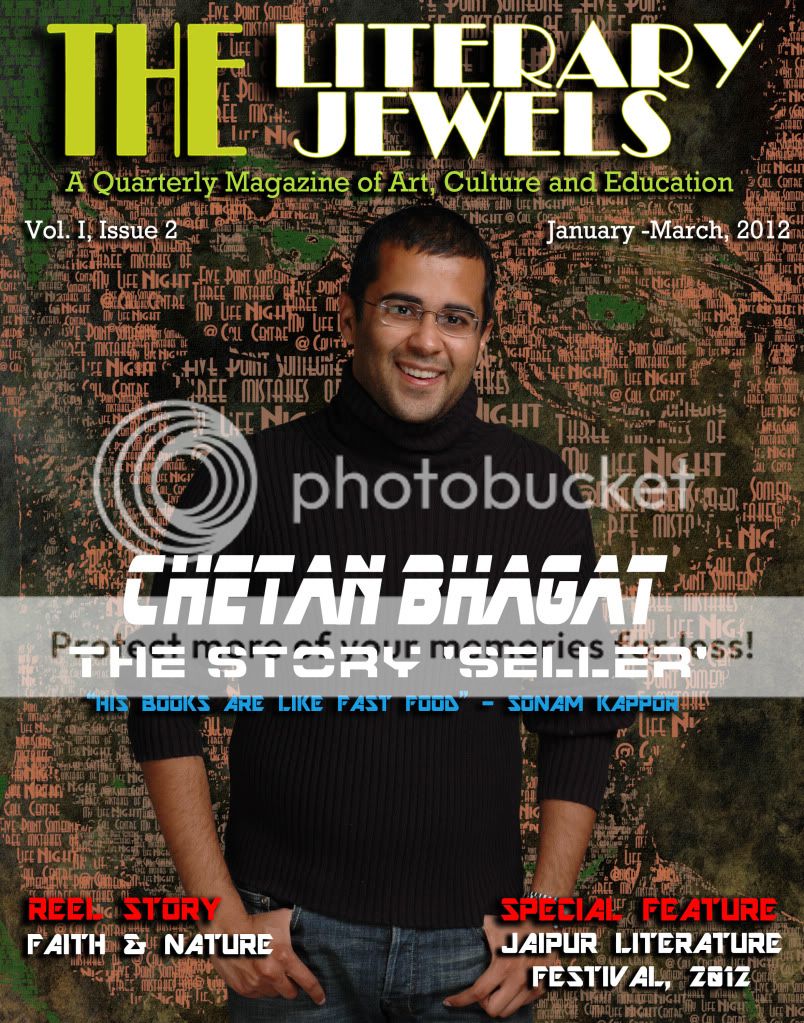
Latest Issue of 'The Literary Jewels'
A GLANCE AT THE CONTENTS:
Cover Story
Chetan Bhagat: The Story 'Seller'
Book Review
Revolution 2020
Photo Essay
Faith and Nature
Special Features
Jaipur Literature Festival 2012
Other Columns:
Telling a Tale
In Philosophical Terms
Words' Worth
Poetic Pleasure
Art and Artifacts
Letters to the Editor
and much more...Read and enjoy
Most importantly, don't forget to give your feedback!